The first time I watched Buenos Aires turn purple I thought someone had Photoshopped the sky. One quiet October morning the bare trees along Avenida del Libertador exploded into a haze of violet-blue, and for a few weeks the whole city seemed to be standing under a lilac cloud. If you can time it, it is one of the most beautiful things this place does.
The Buenos Aires jacaranda season runs through spring — typically late October into November, with the peak most years around mid-November. The bloom is brief, roughly two to four weeks, and the exact dates shift year to year with the weather, so treat any calendar as a rough guide and check current conditions before you book.
Last updated: June 2026 · Written by the Buenos Aires Tourism editorial team
This guide is the one I wish I’d had: when the jacarandas actually flower, where to stand for that full purple-canopy effect (Plaza San Martín, Recoleta, the 9 de Julio, the Bosques de Palermo and more), how to photograph them without fighting the crowds, and how the bloom slots into a wider spring trip. Remember you are in the southern hemisphere here — this is an October-and-November event, not an April one — so it pairs naturally with the city’s loveliest, mildest season.

When is jacaranda season in Buenos Aires?
In a normal year the jacarandas begin to colour up in the second half of October, hit their stride in early November, and peak somewhere around the 15th to the 20th of November. By early December most of the flowers have dropped and the trees fill out with their fine, ferny green leaves instead. If I had to pick one week to fly in for the bloom and nothing else, I would aim for the middle of November and pad my trip with a few extra days on either side as insurance.
Two things are worth understanding. First, the jacaranda (botanically Jacaranda mimosifolia, native to north-western Argentina and Bolivia) flowers before its leaves fully return, which is exactly why the colour reads so intensely — you get solid clouds of violet rather than purple dotted through green. Second, timing genuinely wobbles. A warm, sunny end to winter can pull the bloom forward; a cold, wet spring can push it back or shorten it. Locals will happily argue about whether “this year is early” every single year. Hedge your bets, and don’t pin a once-in-a-lifetime trip to a single fixed date.
A quick at-a-glance timeline
| Period | What to expect | Worth a trip? |
|---|---|---|
| Late October | First flushes of purple; trees still patchy | Early but promising |
| Early November | Colour building fast across the city | Good |
| Mid-November (~15–20) | Usual peak — full purple canopies | Best |
| Late November | Still lovely; first blossoms carpeting pavements | Very good |
| Early December | Fading fast; green leaves taking over | Mostly over |
Because the window is so short and so weather-dependent, it helps to read the bloom as the showpiece of the wider season rather than a guaranteed fixture. For the full picture of why these months top most people’s list, see our guide to the best time to visit Buenos Aires, and our deep dive into Buenos Aires in spring.
Where to see the bloom during Buenos Aires jacaranda season
The honest answer is “almost everywhere” — the city planted these trees by the thousand, and during the peak you genuinely cannot miss them. But some places concentrate them into proper purple tunnels and postcard frames. These are the spots I send everyone to.
Plaza San Martín & Retiro
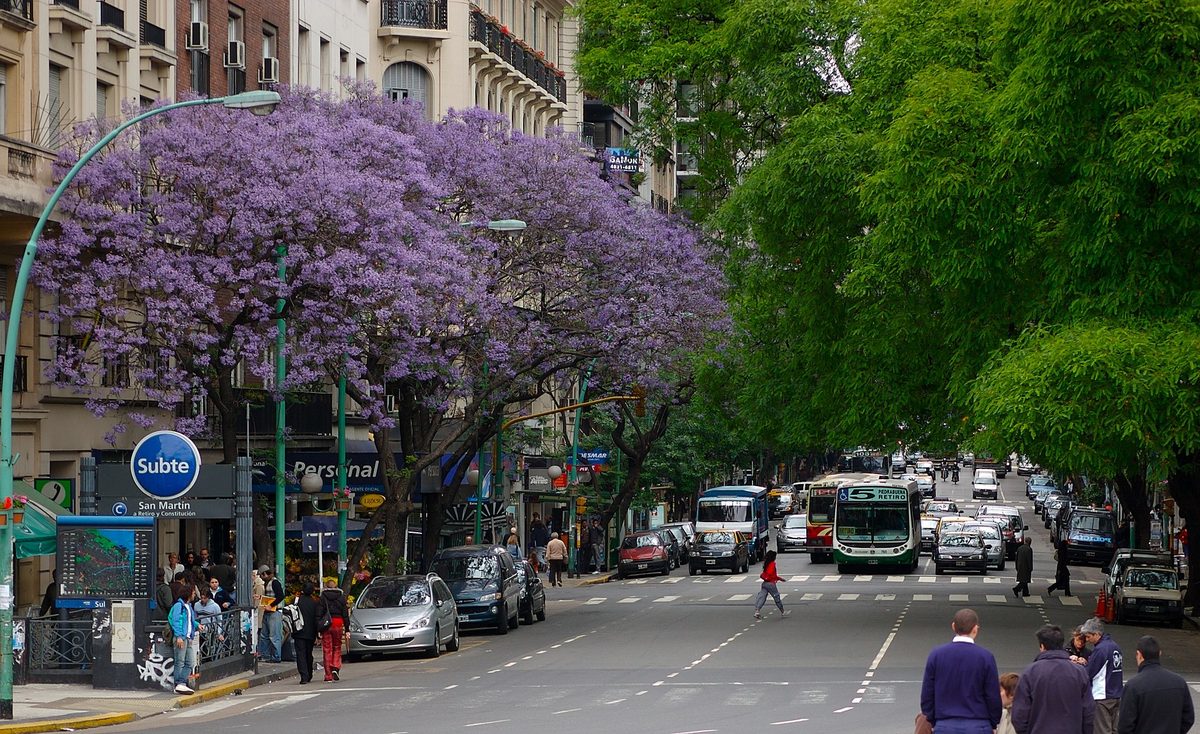
Plaza San Martín is my favourite single place to stand during the bloom. The sloping lawn under enormous old trees, framed by belle-époque palaces and the British clock tower, picks up jacarandas beautifully, and the streets around Retiro — particularly the leafy blocks near the US embassy — hold some of the finest specimens in town. Come early and you can have a whole purple corner of the plaza more or less to yourself.
Recoleta: around the cemetery & Floralis Genérica
Recoleta is jacaranda country. The green spaces spilling out from the famous cemetery around Plaza Francia and Plaza Intendente Alvear fill with violet, and a short walk away the giant steel Floralis Genérica flower sits in its own plaza by the law faculty, ringed by lawns that turn purple in November. The combination of grand architecture, open sky and blossom makes this one of the most photogenic neighbourhoods for the bloom.

Avenida 9 de Julio & the Obelisco
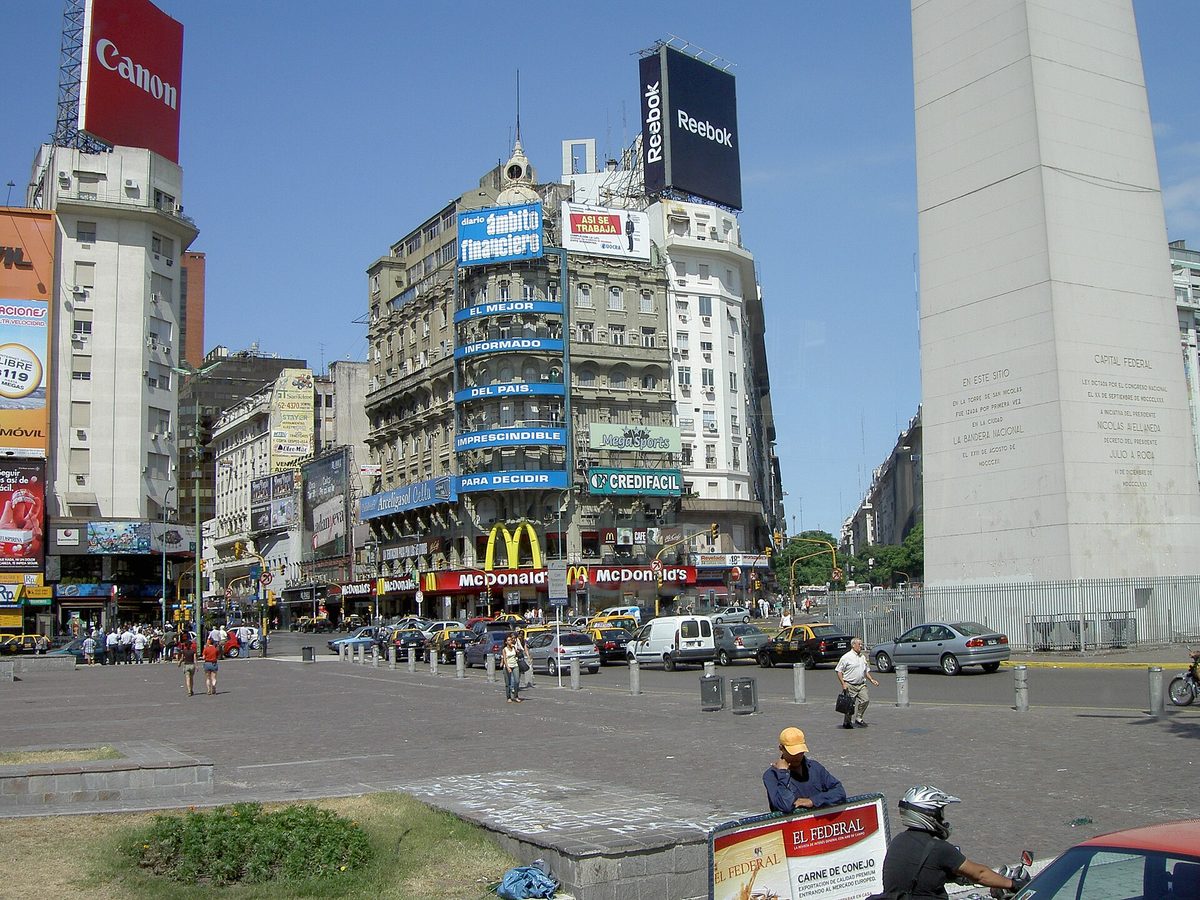
For the “purple meets monumental” shot, head to the 9 de Julio — reputedly one of the widest avenues in the world — where lines of jacarandas soften the traffic and the Obelisco rises behind them. It is busy and a little chaotic, but catching that splash of violet against the city’s most famous landmark is worth braving the crossings for. The blocks running off toward Plaza de Mayo and the Teatro Colón carry the colour too.
Bosques de Palermo & Avenida Sarmiento
The Bosques de Palermo (Parque Tres de Febrero) is where Porteños go to sprawl on the grass under the bloom, mate in hand. Avenida Sarmiento and Avenida Figueroa Alcorta, which thread through the park near the Ecoparque and the Rosedal, form some of the most reliable jacaranda avenues in the city. Pair it with the rose garden, which peaks at the same time, and you have a gloriously flowery morning. There is more on the green spaces in our guide to Buenos Aires parks and gardens.
Belgrano, plazas & the everyday city
Don’t overlook the residential barrios. The Barrancas de Belgrano slopes, Plaza Italia and Plaza Alemania near the park, San Telmo’s Plaza Dorrego and the green axis around Plaza del Congreso all light up, and honestly some of my best jacaranda moments have been on anonymous side streets in Recoleta and Palermo with no other tourist in sight. Wander, look up, and let the city surprise you — it is one of the loveliest free things to do in Buenos Aires at this time of year.
Photography tips for the jacarandas
You do not need a fancy camera — a phone does the bloom justice — but a few habits make a real difference.
- Shoot early or late. The soft light of the first hour after sunrise or the last hour before sunset makes the violet glow; harsh midday sun flattens it and blows out the sky. Early mornings also mean empty plazas.
- Get under the canopy and look up. A wide shot from below, with the purple filling the frame against blue sky, beats a tree photographed from across the street every time.
- Use the fallen carpet. Once blossoms start dropping, the pavements and lawns turn lilac. A low angle that catches both the carpet and the tree above is the signature jacaranda shot.
- Add a landmark. Frame the bloom with the Obelisco, the Floralis Genérica, a Recoleta dome or a grand Retiro façade so the photo says “Buenos Aires,” not just “purple tree.”
- Look for contrast. Violet against pale stone, against the city’s painted balconies, or against a clear sky all sing. Overcast days are fine for close-ups but dull for the big canopy shots.

How the bloom fits into a spring trip
Here is the good news: the jacaranda window falls smack in the middle of the city’s best weather. November days in Buenos Aires tend to run warm and bright — roughly 17–26°C (63–79°F) — with long evenings, blooming parks and a buzzing outdoor cafe scene, before the sticky heat of high summer arrives. You are not choosing between the flowers and a good trip; the flowers are the good trip, layered on top of an already lovely season.
Practically, that means you can build a normal spring itinerary — parrillas, tango, museums, a day by the river — and simply weave the jacarandas through it, ticking off Plaza San Martín on your downtown day and the Bosques on your Palermo day. Pack for changeable spring weather: layers, sunglasses and something for the odd thunderstorm. If you are weighing the seasons against each other, compare it with Buenos Aires in autumn, scan the Buenos Aires weather by month breakdown, and check what’s on in our Buenos Aires events by month calendar so the bloom isn’t the only thing on your plate.
A small cultural note
The jacaranda isn’t a tucked-away botanical curiosity here — it is woven into the city’s self-image. Porteños track the bloom, photograph it obsessively, and treat the first purple streets as the real signal that spring has arrived. The trees line avenues, shade the plazas where people drink mate, and turn an ordinary walk to the shops into something briefly magical. Catching that collective little lift of mood is half the pleasure.
Frequently asked questions
When do jacarandas bloom in Buenos Aires?
Jacarandas in Buenos Aires usually bloom in spring, from the second half of October through November, with the peak most years around mid-November (roughly the 15th to the 20th). The display lasts about two to four weeks. Exact dates shift with the weather each year, so confirm current conditions before timing a trip around it.
What is the best month to see the jacaranda bloom?
November is the safest bet, and mid-November is the classic peak when whole avenues turn solid violet. Late October can reward early visitors with the first flushes, and late November still looks beautiful, with blossoms beginning to carpet the pavements. December is usually too late, as the flowers drop and green leaves take over.
Where are the best places to see jacarandas in Buenos Aires?
Top spots include Plaza San Martín and the streets of Retiro, Recoleta around the cemetery and the Floralis Genérica, the Avenida 9 de Julio near the Obelisco, and the Bosques de Palermo along Avenidas Sarmiento and Figueroa Alcorta. Honestly, though, you will find purple trees on side streets all over the central barrios.
How long does the jacaranda bloom last?
Each year’s bloom typically lasts around two to four weeks from first colour to the last falling petals. Individual trees flower for a shorter spell, but because they don’t all peak at once, the city stays purple for several weeks. A warm spring tends to bring an earlier, faster bloom; a cool, wet one stretches or delays it.
Are jacaranda trees native to Buenos Aires?
The jacaranda (Jacaranda mimosifolia) is native to north-western Argentina and neighbouring Bolivia rather than to Buenos Aires itself, but the city adopted it enthusiastically and planted it widely along avenues and in plazas. Today it is so closely tied to the local spring that most visitors assume it has always belonged here.
Final thoughts
If your dates are flexible, aim for the back half of October into late November and you give yourself the best shot at the purple city. If they are fixed, don’t despair — even a partial bloom is gorgeous, and the season around it is the finest Buenos Aires gets. Go early for the light, look up, and let the jacarandas do their once-a-year magic. For the bigger seasonal picture, our complete guide to the best time to visit Buenos Aires ties it all together.
Photo credits
- Purple jacarandas along a city avenue — Photo: tercerojista / CC BY 2.0 via Wikimedia Commons. File page.
- Jacaranda by the San Martín Subte entrance — Photo: Beatrice Murch / CC BY 2.0 via Wikimedia Commons. File page.
- Facultad de Derecho and the Floralis Genérica, Recoleta — Photo: Beatrice Murch / CC BY 2.0 via Wikimedia Commons. File page.
- Carpet of fallen jacaranda blossoms — Photo: McKay Savage / CC BY 2.0 via Wikimedia Commons. File page.