Last updated: June 2026 · Written by the Buenos Aires Tourism editorial team
I have walked a lot of cemeteries in my time, but none of them prepared me for the first time I stepped through the columned gate at Plaza Francia. Recoleta Cemetery Buenos Aires is the city’s grand necropolis — a walled labyrinth of marble mausoleums laid out like a miniature city, with cobbled “streets”, little plazas and more than 6,400 vaults packed shoulder to shoulder. It is where Argentina buries its presidents, generals, poets and one very famous first lady, and it remains, after every return visit, the single attraction I tell first-timers they cannot skip. Plan on roughly 1 to 1.5 hours, bring a card for the entrance fee, and let yourself get a little lost.
Recoleta Cemetery Buenos Aires at a glance
Here is the quick orientation I wish someone had handed me at the gate. Treat the prices and hours as a guide and confirm the current details on the day — Argentine numbers move with inflation.
| Detail | What to expect (mid-2026) |
|---|---|
| Hours | Open daily, roughly 09:00–17:30 (last entry earlier); check current |
| Ticket | No longer free for visitors — non-residents pay a few US$ (around US$8–15); Argentine residents free with ID; pay by card at the gate |
| How long | About 1–1.5 hours to see the highlights; longer if you wander |
| Where | Junín 1760, on Plaza Francia in Recoleta; entrance beside the Basílica del Pilar |
| Nearest Subte | Line H to Las Heras (about a 5–7 minute walk); buses 17, 60, 67, 92, 110, 130 |
| Best for | History buffs, photographers, architecture lovers, anyone tracing Evita |
For the bigger cultural picture — how the cemetery fits alongside the city’s great collections and concert halls — see our guide to the best Buenos Aires museums and cultural sites. It pairs naturally with a morning at the nearby Museo Nacional de Bellas Artes, a few hundred metres downhill.
Why a cemetery is the city’s must-see
It sounds morbid to send people to a graveyard, but Recoleta is less a place of mourning than an open-air museum of architecture and Argentine history. Until 1822 the city’s dead were buried on church grounds; that November, Governor Martín Rodríguez established Buenos Aires’ first public cemetery on the old orchard of the Recollect friars, the same monks who gave the barrio its name. The French engineer Próspero Catelin, who also laid out the Metropolitan Cathedral, designed it on a grid of blocks and avenues — which is exactly why it feels like a stone city rather than a field of headstones.
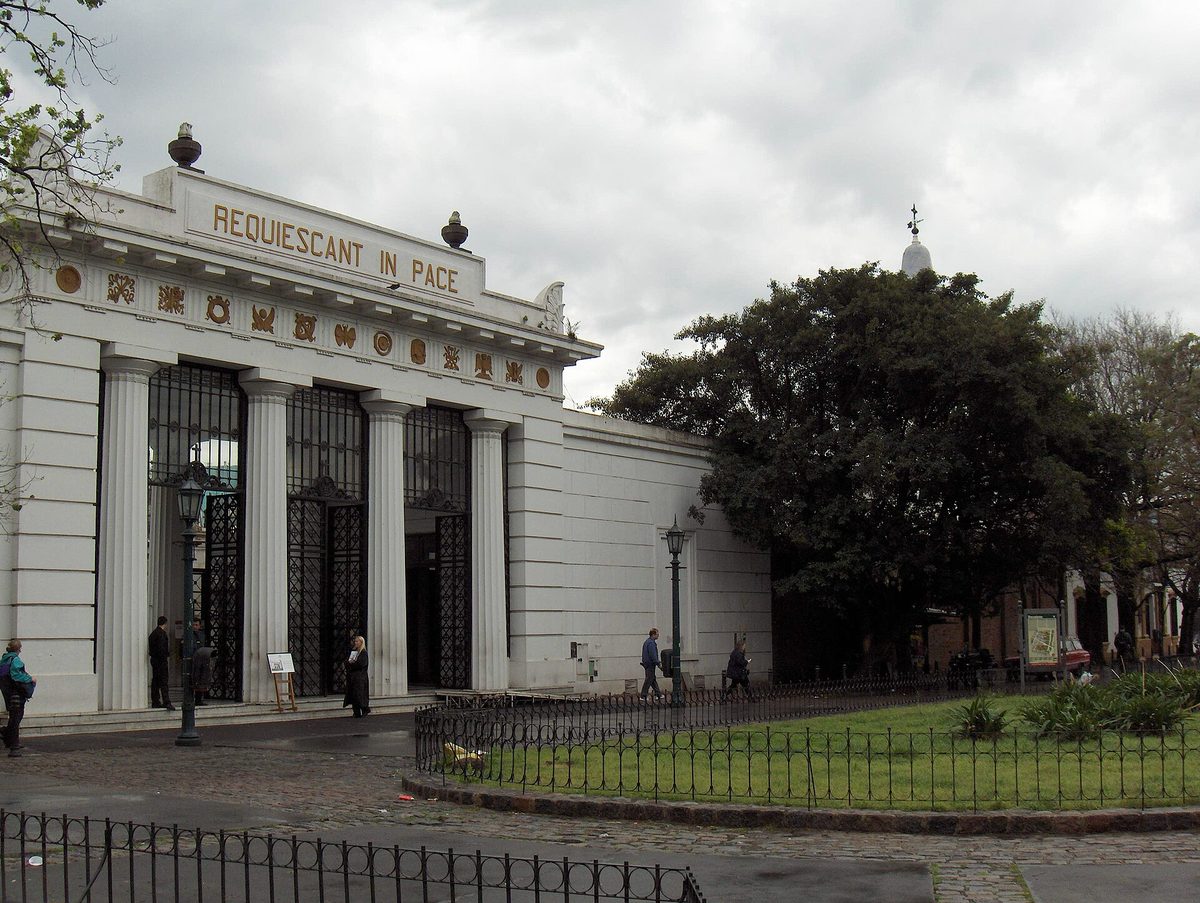
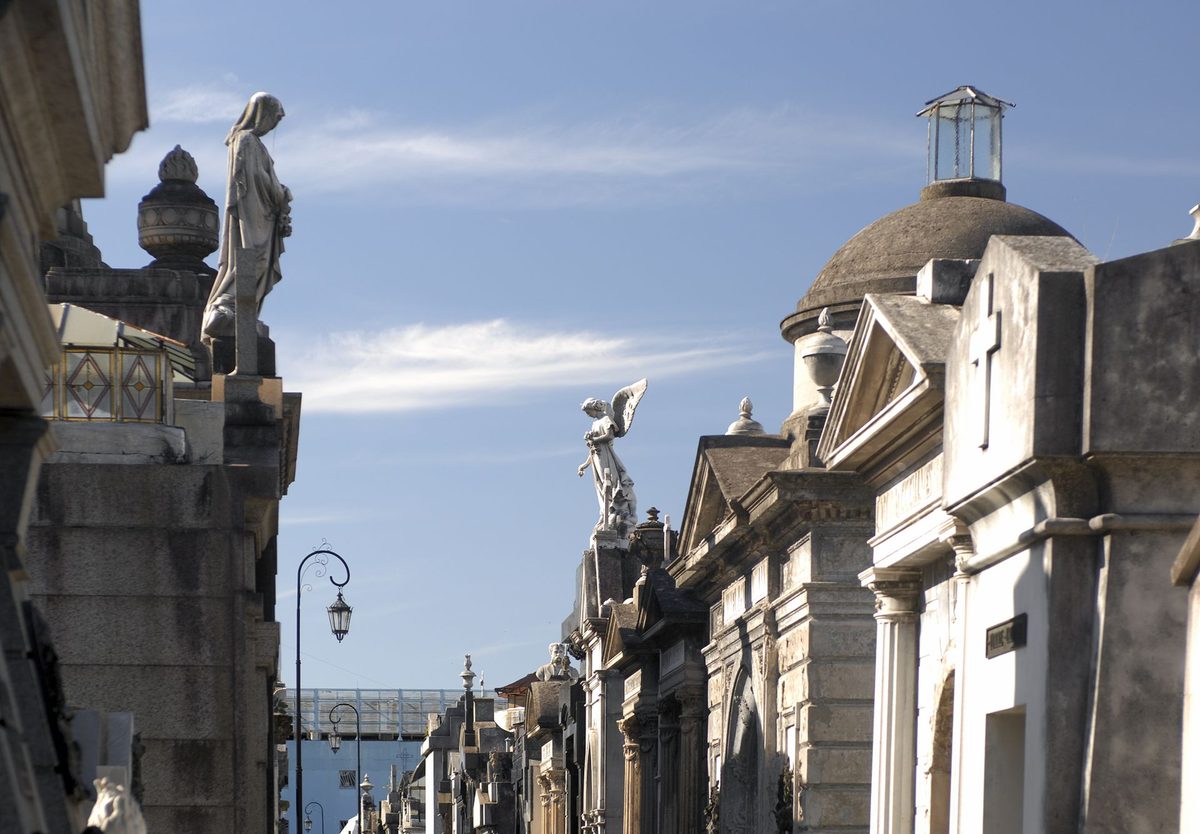
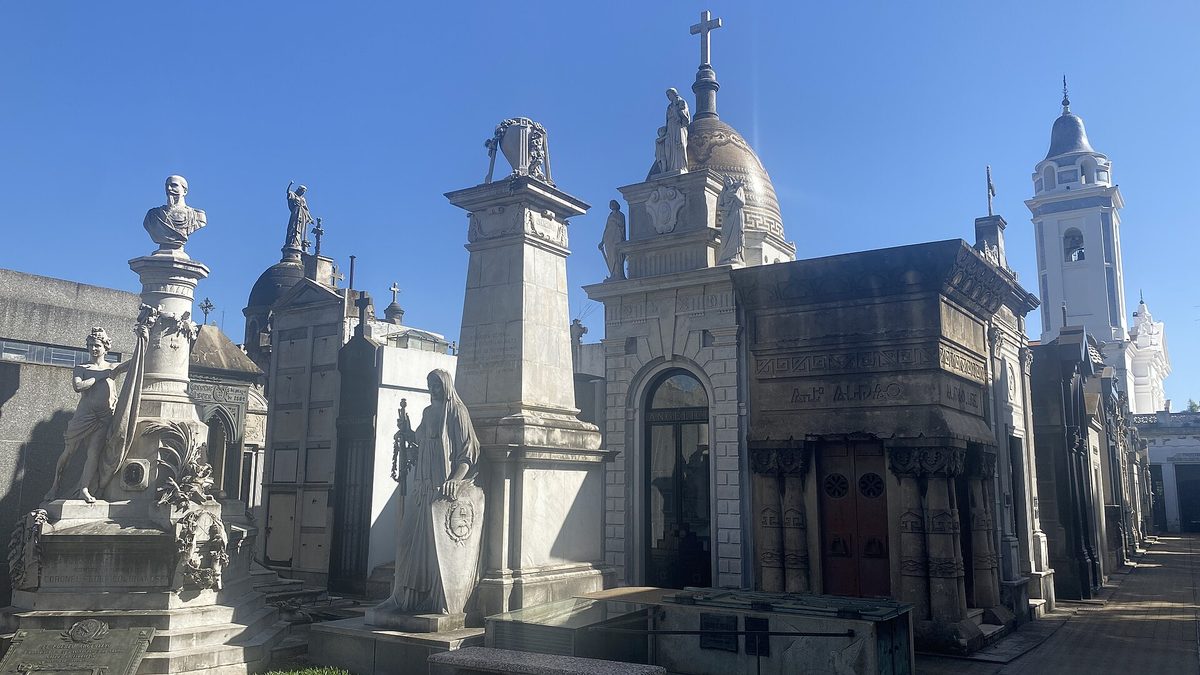
By 1881 the grounds had fallen into disrepair, so Mayor Torcuato de Alvear ordered a full renovation by the Italian architect Juan Antonio Buschiazzo, who built the neoclassical front gate you walk through today: broad Doric columns under the Latin motto Requiescant in Pace. It took the name Cementerio de la Recoleta in 1949. More than 90 of its tombs are now protected national monuments, and the styles read like an architecture syllabus — Art Nouveau, Art Deco, neo-Gothic, baroque and neoclassical crowd together, layered with Masonic symbols and religious iconography. If you love the city’s buildings, this is a concentrated dose; our Buenos Aires architecture guide traces the same styles out across the streets.
Finding Eva Perón’s tomb
This is the grave everyone comes for, so let me save you the wandering. Eva “Evita” Perón is buried in the Duarte family vault — her maiden name was Duarte — and the first thing to know is that it is deliberately modest. Do not look for a soaring monument. The Duarte tomb is a plain, dark, fairly narrow vault on a side passage, easy to walk straight past if it were not for the small crowd and the fresh flowers almost always tucked into its door. From the main entrance, walk straight in along the central avenue and bear left; it sits perhaps 100 to 150 metres in, in the section near the cemetery’s heart. If you get turned around, look for the cluster of phones held aloft — that is invariably the spot.
The understatement is part of the story. Evita died of cancer in 1952 at just 33, yet her body was not laid to rest here for some twenty years — it was hidden, moved abroad and the subject of one of the strangest sagas in Argentine history before finally being interred in 1976. Today she lies in a heavily reinforced crypt around five metres underground, fortified to protect her remains. The simplicity above ground is intentional: the real vault is far below, and she remains the emotional centre of the whole necropolis. The cemetery sits within the wider Recoleta neighbourhood, an easy half-day once you fold in the church and museums next door.
The other graves worth hunting down
Evita is the headline, but the supporting cast is what makes a slow loop here so rewarding. A few I always point people toward:
- The presidents. Domingo Faustino Sarmiento — the great 19th-century educator-president — lies here, as does Raúl Alfonsín, the president who steered Argentina back to democracy in 1983; his is among the most visited modern graves. Several other heads of state are scattered through the blocks.
- The Paz family mausoleum. The owners of the Palacio Paz and the newspaper La Prensa rest in a majestic black-stone structure adorned with giant marble angels and Masonic imagery — one of the most photographed tombs in the grounds.
- Rufina Cambacérès. Recoleta’s most haunting legend. In 1902, aged 19, Rufina was declared dead and interred — only for workers to later find scratch marks inside the coffin and on her face. She is thought to have suffered catalepsy and woken after burial. Her grieving mother commissioned the exquisite Art Nouveau tomb in Carrara marble, with a life-size bronze of Rufina stepping through a half-open door. It is unmissable, and quietly devastating.
- David Alleno, the gravedigger. Recoleta’s resident ghost is a caretaker who dug graves here for 30 years, saving for his own plot and a statue of himself. As the story goes, once the statue was finished he took his own life — and you can still hear his keys jangling along the paths at dawn.
- Liliana Crociati de Szaszak. A young bride who died on her honeymoon in the 1970s; her parents recreated her bedroom inside the tomb and placed a bronze of Liliana in her wedding dress at the door, her pet dog at her side.
- Writers and sportsmen. The poet José Hernández, author of the gaucho epic Martín Fierro, and the heavyweight boxer Luis Ángel Firpo — “the Wild Bull of the Pampas” — both lie among the presidents, a reminder that in death, as one local put it, only the most influential Argentines earn a ticket here.
How to navigate the “streets” of the dead
The genius of Recoleta is its layout. Because Catelin designed it as a city, it has numbered blocks, named avenues, signposts and benches — you navigate it like a tiny town. The wide central avenue runs straight from the gate; off it branch narrow alleys where the mausoleums press so close two people can barely pass. Look up: the skyline is a forest of domes, crosses, weeping angels and stone urns, with the Basílica’s white bell tower peeking over the walls.
You do not need a guide, but you do need a plan or you will drift. The two reliable approaches:
- Grab the map at the entrance. There is a numbered map by the gate showing dozens of the important tombs; printed maps are usually sold nearby too. With it you can plot a route to the graves you care about and still wander off-piste in between.
- Take a guided tour. The city runs free guided walks in Spanish (historically around 11:00 and 14:00 on weekdays, 11:00 and 15:00 at weekends — check current times). English tours are generally run by private operators for a small fee and add a layer of history and gossip you will not get from the map alone.
Honestly, half the pleasure is simply getting lost. The grid is small enough that you can always find your way back to the central plaza or the gate, but dense enough that every visit turns up a vault you missed last time. If you would rather have the cemetery folded into a wider stroll of the historic city, our Buenos Aires walking tour guide sets out routes that link it to other landmarks.
Planning your visit: hours, tickets and getting there
The single biggest update for 2026: Recoleta Cemetery is no longer free. A paid entrance for non-residents was introduced around 2022, so foreign visitors now buy a ticket — figure on a few US dollars (roughly US$8–15 as of mid-2026, though the peso price climbs with inflation, so verify on the day). Argentine residents still enter free with valid ID. You buy at the gate and pay by card — since Argentina lifted most currency controls in 2025, foreign cards are charged near the official rate, so the old “bring a wad of cash” advice is outdated. For budget days around it, our guide to free things to do in Buenos Aires is a handy companion.
Hours run daily, roughly 09:00 to 17:30 (some sources still list 08:00–18:00); either way, go in the morning for soft light and thinner crowds. Getting there is easy: the closest Subte is Line H to Las Heras, about a five-minute walk, with buses 17, 60, 67, 92, 110 and 130 nearby, and a taxi from the centre is cheap. Wear comfortable shoes — the lanes are uneven cobble and old stone — and give yourself an hour to ninety minutes. It slots neatly into a day of the city’s other top sights.
The Recoleta barrel: what’s right outside
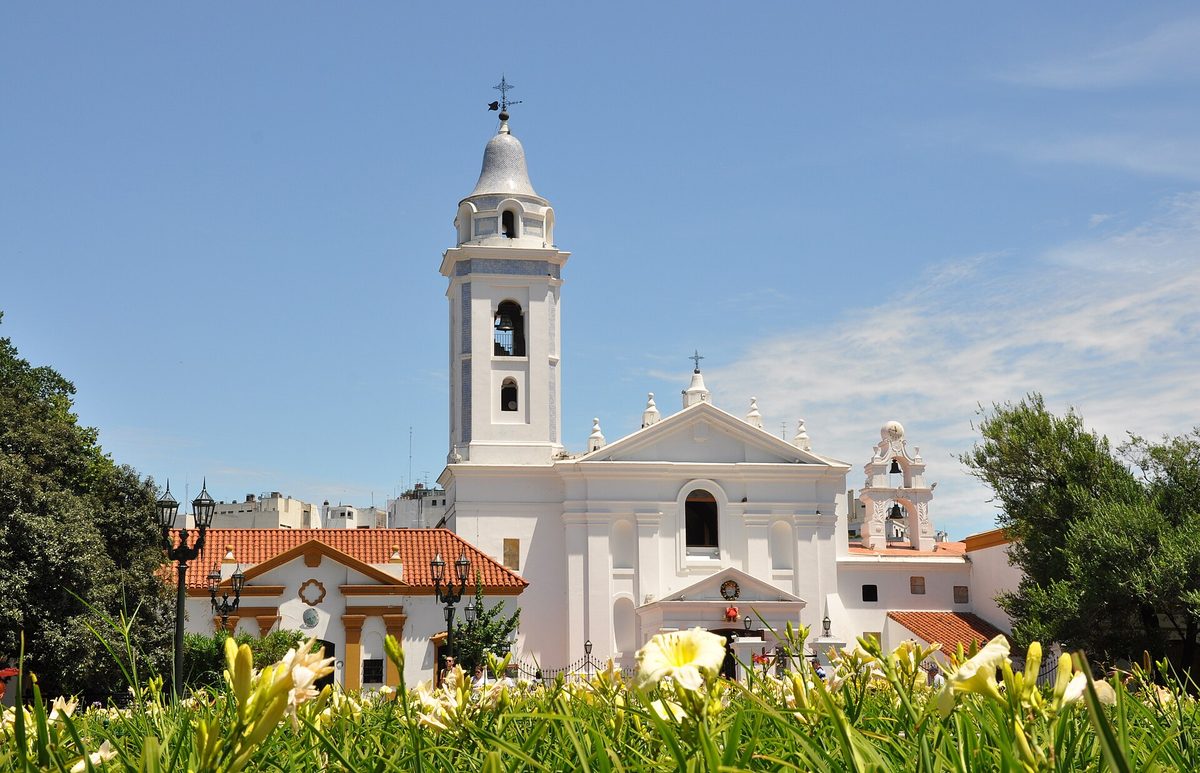
One of the joys of Recoleta is that you never have to travel far for the next thing. The cemetery sits in the middle of a tight cluster of culture, and I would budget extra time for it. Step out of the gate and the gleaming white Basílica de Nuestra Señora del Pilar is right there — a baroque colonial church from the 1730s, one of the oldest in the city, whose orchard the cemetery once was; its silver altar alone is worth the look. Next door, the Centro Cultural Recoleta occupies the old convent buildings and hosts free contemporary exhibitions, concerts and workshops under a striking glass dome.
Across the sloping lawns of Plaza Francia, the weekend feria (craft and design fair) fills Saturdays and Sundays with stalls of leather, mate gourds, jewellery and street food. And a short walk downhill brings you to the Museo Nacional de Bellas Artes, free to enter and the natural art pairing with a cemetery morning. Together these make Recoleta one of the densest culture corners in town — reason enough to read our round-up of the best museums in Buenos Aires and our overview of the city’s museum scene before you go.
Who it suits — and is it worth it?
Let me be direct, because I get asked this constantly. Yes, Recoleta is worth it — for most visitors it is the one unmissable sight in Buenos Aires. If you love history, architecture or photography, you could happily lose half a day here. With curious kids, the “city of the dead” framing and the ghost stories tend to fascinate rather than frighten, though the cobbles ask for patience. The only travellers I would steer elsewhere are those with real mobility issues (the uneven lanes are tough going) or anyone who finds cemeteries upsetting — no shame in admiring the basilica and feria from outside instead. For everyone else, the mix of art, history and that strange, beautiful hush is unforgettable. Keep your voice down, don’t climb on the tombs, and treat it as the working cemetery it still is.
Recoleta Cemetery FAQ
Is Recoleta Cemetery free?
No, not any more for visitors. A paid entrance for non-residents was introduced around 2022, so foreign tourists now buy a ticket — expect a few US dollars (roughly US$8–15 as of mid-2026, though the peso price shifts with inflation). Argentine residents enter free with valid ID. You pay at the gate, and cards are accepted, so there is no need to bring a stack of cash.
Where is Eva Perón buried?
Eva Perón — Evita — is buried in the Duarte family vault (her maiden name), a deliberately modest dark tomb on a side passage about 100 to 150 metres in from the main gate. Walk straight in and bear left; the small crowd and the fresh flowers give it away. Her remains lie in a fortified crypt around five metres underground, so the simple exterior hides a heavily protected resting place.
How long do you need at Recoleta Cemetery?
Plan on about one to one and a half hours to see the main highlights — Evita, the presidents, the Paz mausoleum and Rufina Cambacérès — at a comfortable pace. A guided tour runs roughly 90 minutes. If you enjoy wandering, photographing the statuary or hunting down lesser-known vaults, you could easily spend two or three hours and still not see everything.
Is Recoleta Cemetery worth visiting?
Absolutely. It is consistently rated one of the most beautiful cemeteries in the world — an open-air gallery of marble mausoleums in Art Nouveau, Art Deco, neo-Gothic and baroque styles, with more than 90 tombs listed as national monuments. Between the architecture, the history and the chance to pay respects at Evita’s grave, it is the attraction most first-time visitors should not miss.
Final thoughts
Recoleta rewards a slow, curious visit more than a checklist one. Go in the morning, take the map, find Evita, then put the map away and let the avenues of angels and domes do their work. Pair it with the basilica next door, the cultural centre, the weekend feria and the free fine-arts museum downhill, and you have one of the richest half-days in the city. For everything else worth your time in Buenos Aires, start with our things to do in Buenos Aires guide and our museums and culture overview.
Photo credits
- Entrance gate from Plaza Francia — Photo: Sking / CC BY-SA 3.0 via Wikimedia Commons.
- Marble mausoleum with angels and dome — Photo: Godot13 / CC BY-SA 4.0 via Wikimedia Commons.
- Streets of vaults and statuary — Photo: lamblukas / CC BY 2.0 via Wikimedia Commons.
- Basílica del Pilar beside the cemetery — Photo: Butterfly austral / CC BY-SA 3.0 via Wikimedia Commons.