Last updated: June 2026 · Written by the Buenos Aires Tourism editorial team
The first time I walked up Avenida de Mayo, I genuinely forgot which continent I was on: Parisian mansard roofs, a Madrid-style café, and a skyscraper crowned by a working lighthouse, all in three blocks.
Buenos Aires architecture is the reason the city is nicknamed “the Paris of South America”. Between roughly 1880 and 1930, a wealthy, immigrant-fuelled capital hired French, Italian and British architects to build Beaux-Arts palaces, eclectic landmarks, Art Nouveau cafés and Art Deco towers. This guide organises the city’s best historic buildings by style, with named examples and the neighbourhoods to find them, so you can plan a self-guided look.
Why Buenos Aires architecture looks European
The short version: money, immigration and timing. Between 1857 and 1930, nearly six million Europeans — mostly Italians and Spaniards, plus influential French, British and German minorities — arrived just as Argentina grew staggeringly rich on beef and grain. Its elite wanted a capital that announced that wealth, so they looked to Paris, importing architects such as Louis Sortais and Mario Palanti while French landscape designer Charles Thays laid out the parks and avenues. The result is not one style but a deliberate, eclectic mix, and learning to read it turns an ordinary walk into a treasure hunt. For the bigger picture, start with our guide to Buenos Aires museums and culture.
At a glance: ten landmark buildings
Here is a quick reference to the buildings in this guide. Tour availability, hours and prices change often in Buenos Aires, so treat the “can you go in?” column as a starting point and check current details.
| Building | Style | Neighbourhood | Can you go in? | Best for |
|---|---|---|---|---|
| Palacio Barolo | Eclectic / Dante-inspired | Monserrat (Av. de Mayo) | Yes — guided tours | Rooftop lighthouse & views |
| Palacio de Aguas Corrientes | Eclectic (glazed tiles) | Balvanera | Lobby & small museum | The most extravagant façade |
| Casa Rosada | Italianate / eclectic | Monserrat (Plaza de Mayo) | Free weekend tours (book) | History & the “Evita balcony” |
| Teatro Colón | Eclectic (Renaissance/Baroque) | San Nicolás | Yes — daily tours | The opera-house interior |
| Palacio del Congreso | Neoclassical | Balvanera | Free tours (book ahead) | Domes & civic grandeur |
| Palacio Paz (Círculo Militar) | French Beaux-Arts | Retiro | Guided tours | Argentina’s largest mansion |
| Kavanagh building | Art Deco / Rationalist | Retiro | Exterior only (private) | 1930s skyscraper drama |
| Confitería del Molino | Art Nouveau | Balvanera | Reopening — check | Belle Époque café detail |
| Café Tortoni | Belle Époque interior | Monserrat (Av. de Mayo) | Yes — it’s a café | Atmosphere over coffee |
| Biblioteca Nacional | Brutalist / modernist | Recoleta | Yes — free entry | Concrete on stilts |
French Beaux-Arts & Belle Époque palaces
This is the look people mean by “Parisian”: symmetrical stone façades, mansard roofs and grand staircases. Argentina’s elite built private palacios in this French academic style across Retiro, Recoleta and Barrio Norte; many are now embassies or clubs, and some open their doors.
The heavyweight is the Palacio Paz on Plaza San Martín. Built from 1902 to 1914 by French architect Louis Sortais for press baron José C. Paz, founder of La Prensa, it remains the largest single residence ever built in Argentina — roughly 12,000 square metres and around 140 rooms, with interiors that openly quote Versailles. It now houses the Círculo Militar (an army club), with guided tours on most days. Nearby, stroll Avenida Alvear for a parade of French town houses and embassy mansions; to combine this barrio with the cemetery and Bellas Artes, see our Recoleta neighbourhood guide.
Eclectic icons: Barolo & the “Water Palace”
Eclecticism — mixing motifs from different eras in one building — produced the city’s two most delightfully eccentric landmarks.
Palacio Barolo
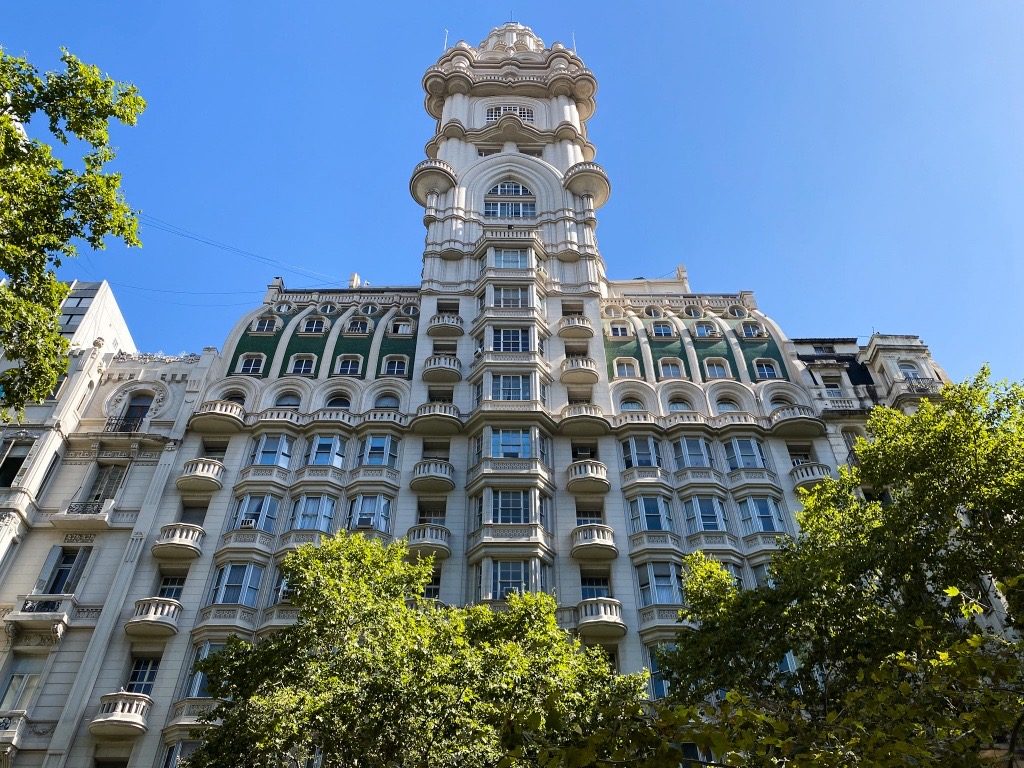
If you visit one building from this guide, make it this one. Completed in 1923 on Avenida de Mayo, the Palacio Barolo was then the tallest skyscraper in South America. Italian architect Mario Palanti designed all 22 storeys around Dante’s Divine Comedy: Hell at the base, Purgatory in the middle, Heaven in the soaring tower, the height of around 100 metres nodding to the poem’s 100 cantos. At the very top a working lighthouse still rotates over the rooftops, the only urban lighthouse of its kind in Latin America. Guided tours climb to the tower for one of the best views in the city, with popular evening tours when the beacon is lit; book ahead.
Palacio de Aguas Corrientes
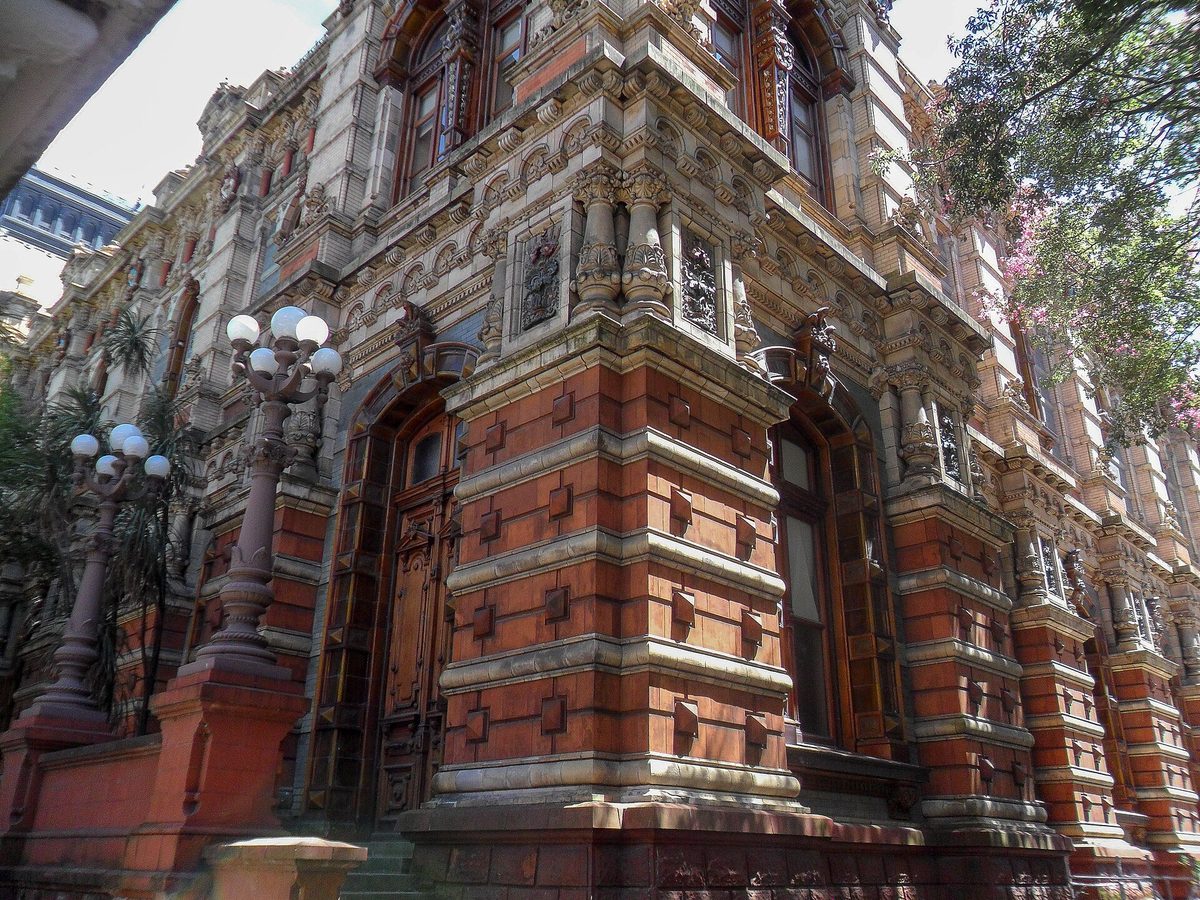
Now for something completely different: a water-pumping station so ornate it looks like a royal residence. The Palacio de Aguas Corrientes on Avenida Córdoba was built between 1887 and 1894 to hold the city’s drinking-water tanks after the epidemics that forced Buenos Aires to modernise. Norwegian architect Olaf Boye wrapped a purely industrial iron structure — some 180 cast-iron columns supporting twelve huge tanks — in a fantastical shell of over 300,000 glazed terracotta tiles shipped from England. The pumps retired in 1978; today it holds offices and a quirky little museum, and you can usually visit the lobby and museum free — check current access.
The civic core: Plaza de Mayo & the Congreso
The Avenida de Mayo runs dead straight for about fifteen blocks between the executive Casa Rosada on Plaza de Mayo and the legislative Palacio del Congreso — the best architecture stroll in the city.
Casa Rosada
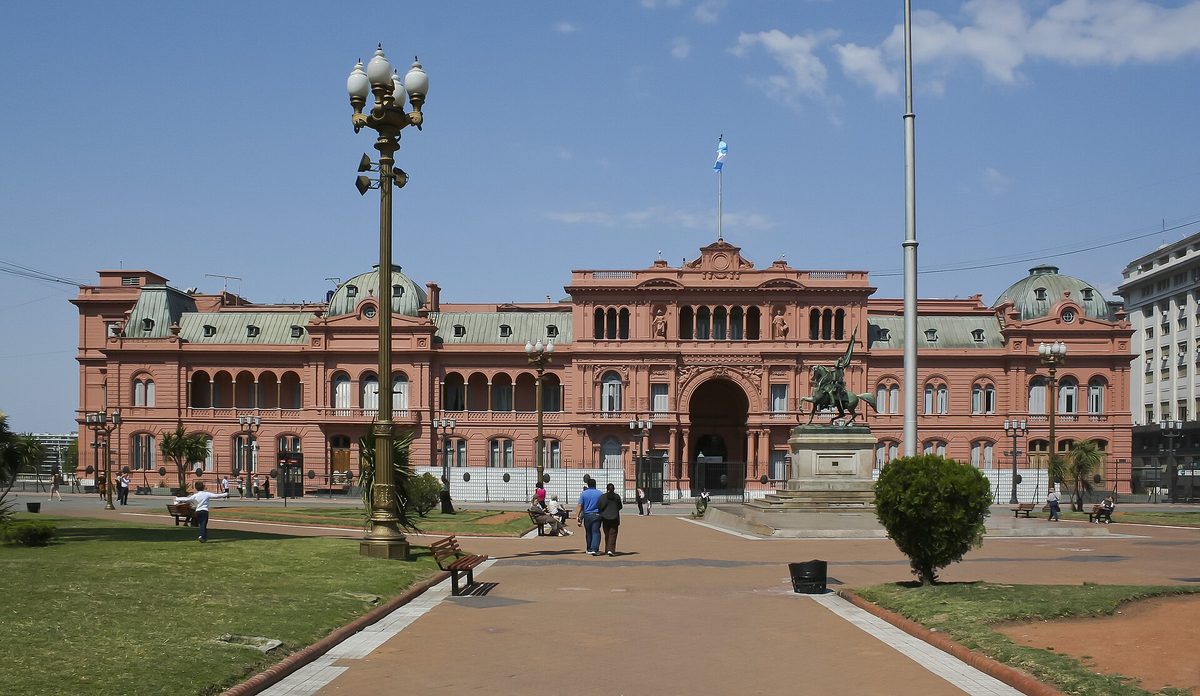
The salmon-pink presidential palace closes the eastern side of Plaza de Mayo. Its Italianate façade, with a triple-arched portico and green-domed corner pavilions, took shape in the 1880s. The balcony on the left is the famous “Evita balcony”, where Juan and Eva Perón addressed the crowds in the late 1940s. Free guided tours run on weekends and take in the patios, the hall of busts and the balcony itself; reserve ahead, as they book up.
Palacio del Congreso
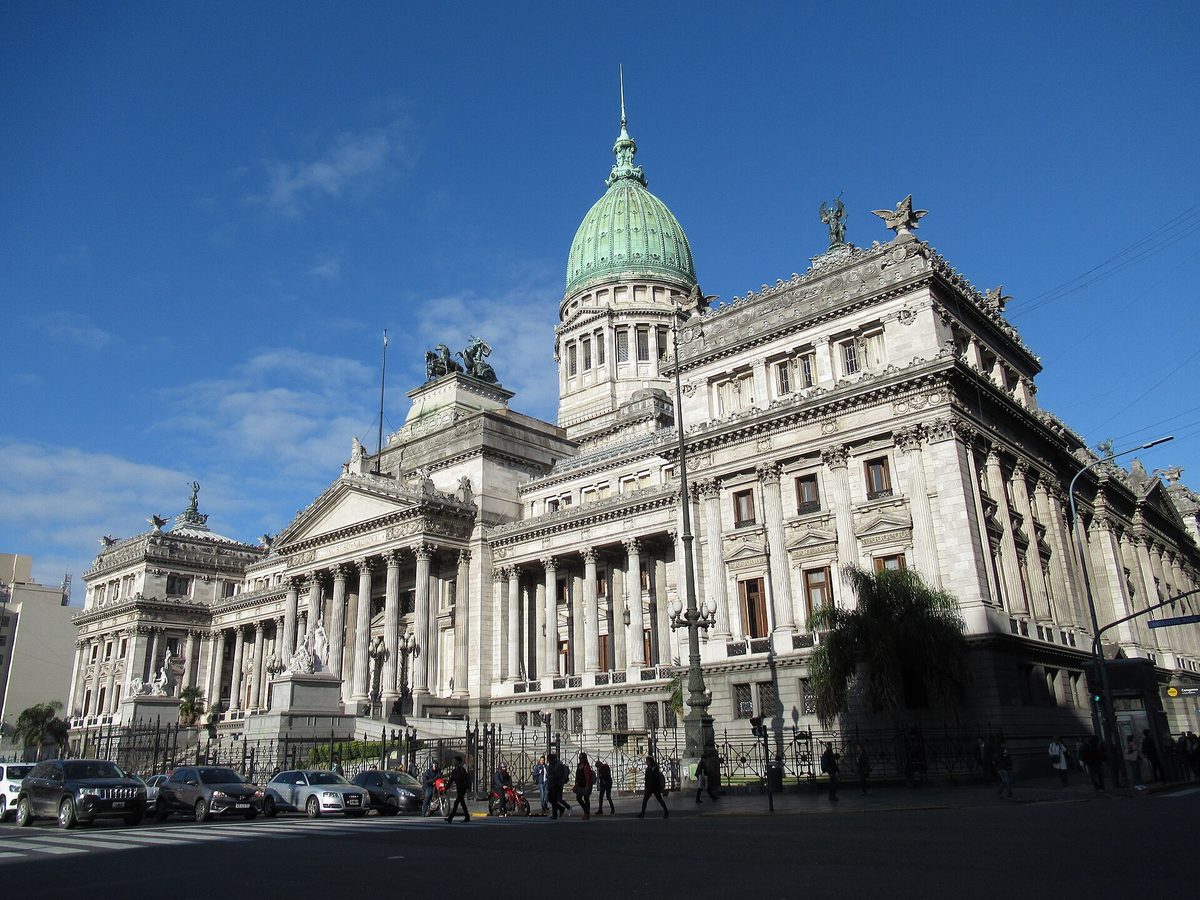
At the western end, the National Congress is the city’s grandest neoclassicism: a Greco-Roman temple of columns, pediments and allegorical bronzes crowned by an 80-metre green dome. Designed largely by Italian architect Vittorio Meano and inaugurated in 1906, it broadcasts Enlightenment ideals of order and reason. Free tours of the chambers run on certain days if you book ahead and bring ID.
Avenida de Mayo & the grand boulevard
The Avenida de Mayo, cut through the city in the 1890s, was modelled on the boulevards of Paris and still feels like a slice of Europe transplanted whole. Beyond the Barolo, step into the Café Tortoni (open since 1858), the city’s most storied café, all marble, stained glass and dark wood. This is prime walking territory: our Buenos Aires walking tour guide threads these landmarks together, and the surrounding Microcentro guide covers the banking palaces and Galerías Pacífico nearby.
Teatro Colón: the opera house
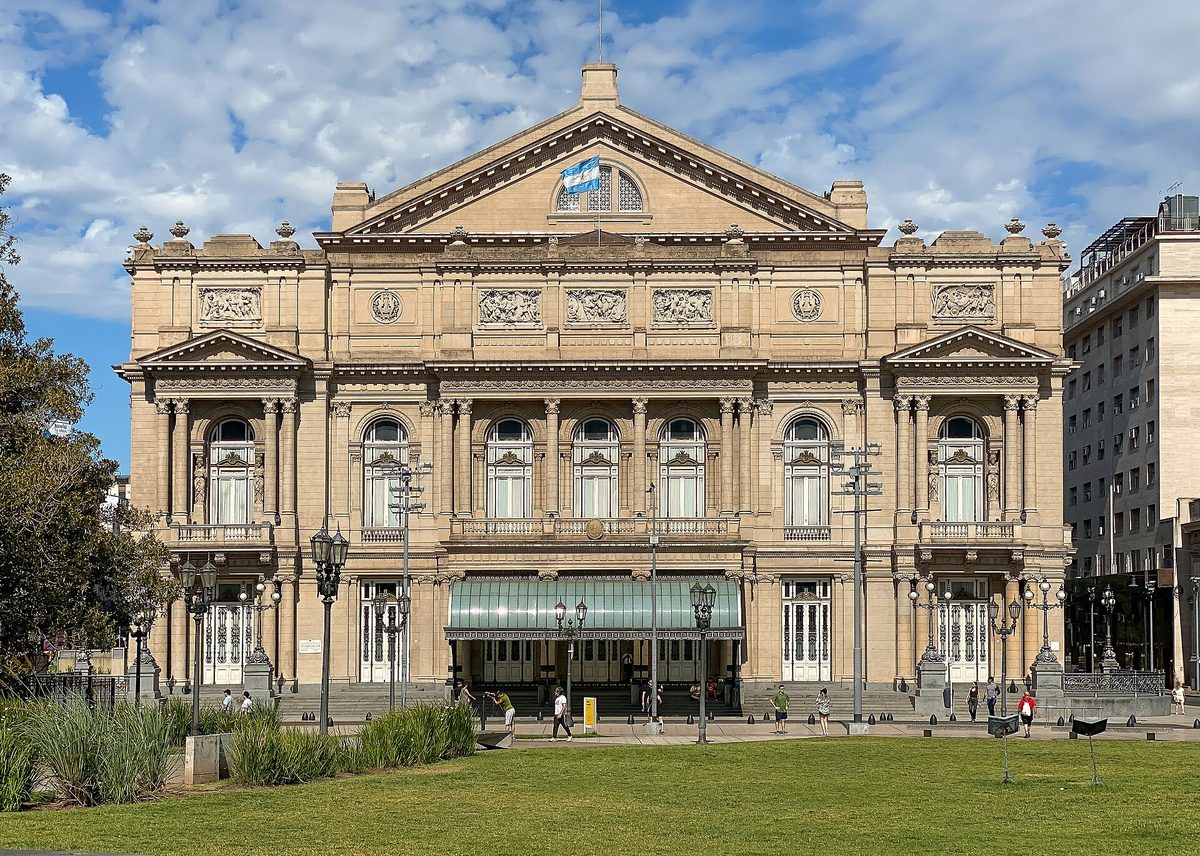
Two blocks off the avenue stands the building most porteños would name as their finest. The Teatro Colón, inaugurated in 1908, is an eclectic blend of Italian Renaissance, French Baroque and Greek classicism, and its near-perfect acoustics rank it among the world’s greatest opera houses. The marble Golden Hall and the great horseshoe auditorium under its painted dome are best seen on a guided tour, which run daily in several languages; the season runs about March to December. It deserves its own visit — see our dedicated Teatro Colón guide.
Art Nouveau & Art Deco
Art Nouveau — curving lines and floral ironwork — arrived first; its sweetest survivor is the Confitería del Molino beside the Congreso, a 1916 café by Francesco Gianotti topped by a stained-glass windmill, long shuttered but under restoration. Then came Art Deco, all geometry and clean vertical lines, whose masterpiece is the Kavanagh building (1936) above Plaza San Martín: at around 120 metres it was the tallest building in Latin America when it opened. Legend says the wealthy Corina Kavanagh built it partly to spite a rival family by blocking their view of the Basilica del Pilar; it is privately occupied, so admire it from the square.
Modernist & brutalist landmarks
The story doesn’t end in the 1930s, and the most striking modern statement is the Biblioteca Nacional (National Library) in Recoleta. Designed in 1961 by Clorindo Testa with Francisco Bullrich and Alicia Cazzaniga, and inaugurated in 1992 after long delays, it is celebrated brutalism: a vast concrete reading-room block raised on four massive legs above an open park, so the gardens flow beneath. ArchDaily has ranked it among the world’s best brutalist buildings, and entry is free. Testa’s curving former Banco de Londres in the Microcentro is a second must-see for concrete fans.
A self-guided look, by neighbourhood
To see a lot without a tour, anchor each style to a barrio and walk. The historic centre (Monserrat and San Nicolás) packs in Plaza de Mayo, the Avenida de Mayo and the Teatro Colón in half a day; Balvanera holds the Congreso, the Confitería del Molino and the Water Palace; Retiro’s Plaza San Martín is ringed by the Palacio Paz and the Kavanagh; and Recoleta adds Avenida Alvear’s mansions, the Biblioteca Nacional and the cemetery.
Recoleta Cemetery belongs on any architecture itinerary in its own right; see our Recoleta Cemetery guide and pair the day with the best museums in Buenos Aires across the park. For a sublime interior, the Beaux-Arts bookshop El Ateneo Grand Splendid is a short detour.
Planning notes (2026)
Tours, hours and prices shift constantly here with inflation, so confirm on the day — I have deliberately avoided printing fixed peso figures. Where buildings charge, expect a few US dollars, up to perhaps US$15–25 for marquee guided experiences such as the Barolo or Teatro Colón. Good news: since Argentina lifted most currency controls in 2025, foreign cards are charged close to the official rate and the old “bring cash for the blue dollar” advice is outdated. Our blue-dollar guide and currency tips keep it current.
Who it’s for — and what to skip
If you love history, design or a good city walk, Buenos Aires architecture is a highlight, and most of it is free just by looking up. Go inside the Barolo and the Teatro Colón — those interiors justify the ticket — and detour to the free Palacio de Aguas Corrientes and Biblioteca Nacional.
Frequently asked questions
Why is Buenos Aires architecture so European?
Because it was built that way on purpose. During Argentina’s export boom of roughly 1880–1930, a wealthy capital absorbing millions of European immigrants hired French, Italian and British architects to recreate the grandeur of Paris, Madrid and Rome — Beaux-Arts palaces, Italianate public buildings and tree-lined boulevards — giving the city its enduring “Paris of South America” look.
What is Palacio Barolo?
The Palacio Barolo is a 1923 landmark on Avenida de Mayo, once the tallest building in South America. Italian architect Mario Palanti designed its 22 storeys around Dante’s Divine Comedy — Hell, Purgatory and Heaven rising floor by floor — and topped it with a working lighthouse unique in Latin America. Guided tours climb to the tower for sweeping views; book ahead.
What is the Palacio de Aguas Corrientes?
It is a working-turned-historic water-pumping station from 1894, and one of the most extravagant buildings in the city. Behind a façade of more than 300,000 glazed terracotta tiles imported from England, an iron skeleton once held twelve giant water tanks. Today it houses water-company offices and a small free museum on Avenida Córdoba in Balvanera; check current opening days.
What architectural styles are in Buenos Aires?
Almost all of them, layered together: Spanish colonial (the Cabildo), neoclassical (the Congreso, Casa Rosada), eclectic (Palacio Barolo, the Water Palace, Teatro Colón), French Beaux-Arts (Palacio Paz), Art Nouveau (Confitería del Molino), Art Deco (the Kavanagh building) and brutalist modernism (the Biblioteca Nacional). That deliberate mix is what makes the city so rewarding to wander.
Final thoughts
Buenos Aires doesn’t hand you its architecture in one famous monument; it spreads it across the whole city and asks you to look up. Walk Avenida de Mayo, climb the Barolo at dusk, press your nose to the tiled façade of the Water Palace, and you’ll understand why people reach for the Paris comparison — and why it never quite fits, because this eclectic, theatrical city is entirely its own. For the wider cultural picture, our Buenos Aires museums and culture guide ties the buildings to everything that happens inside them.
Photo credits
- Palacio Barolo — Photo: EEJCC (CC0) via Wikimedia Commons.
- Palacio de Aguas Corrientes — Photo: Sergio Moises Panei Pitrau (CC BY 4.0) via Wikimedia Commons.
- Casa Rosada — Photo: Diego Delso (CC BY-SA 3.0) via Wikimedia Commons.
- Teatro Colón — Photo: EEJCC (CC0) via Wikimedia Commons.
- Palacio del Congreso — Photo: Felipe Restrepo Acosta (CC BY-SA 4.0) via Wikimedia Commons.